Now the swamp changes hands. Railroad lines reaching the area by eighteen eighty-one speeded up the change from frontier to industry.
In eighteen ninety-one, the Suwannee Canal Company bought the swamp from the State of Georgia. That's about two hundred thirty-eight thousand acres. They meant to drain it for rice, sugar cane and cotton.
Captain Henry Jackson and his crews dug the Suwannee Canal between eighteen ninety-two and eighteen ninety-seven. They used steam-powered dipper dredges.
The Nomination Text says eighteen and a half kilometers in one place, and nineteen in another. That's better than eleven miles. It was about thirty feet wide and an estimated eight feet deep.
The draining failed, and the company turned to logging. The Charlton County Historical Society says the failed project became known as Jackson's Folly.
The company went bankrupt and sold out to Charles Hebard in nineteen oh one. The Hebard Cypress Company began logging in nineteen oh nine.
Loggers ran railroads on pilings deep into the swamp. The Nomination Text says a logging camp on Billys Island once supported six hundred people. Today, a few bits of equipment and brick chimney piles are about all that remains.
The rails were pulled up after each area was logged. The old paths still show faintly on aerial photos.
More than a million cubic meters of timber came out of the swamp by nineteen twenty-seven. That's when Hebard finally stopped. Other loggers kept cutting until nineteen forty-two, on land the government had not bought.
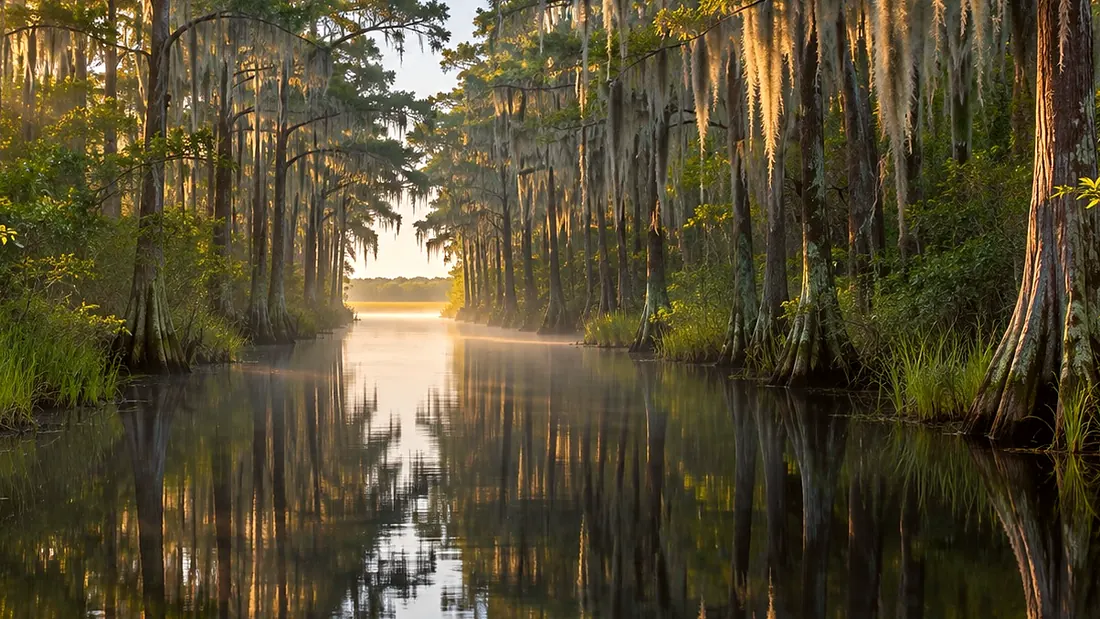
Old-growth cypress, five hundred years or older, is left on only about two thousand acres. Large areas were never harvested, because they were hard to reach or the timber did not pay.
The text does say the swamp has had only one episode of major development. The canal, then the logging.